
Liver, Kidney and Pancreas Transplants
Kidney and Pancreas Transplant
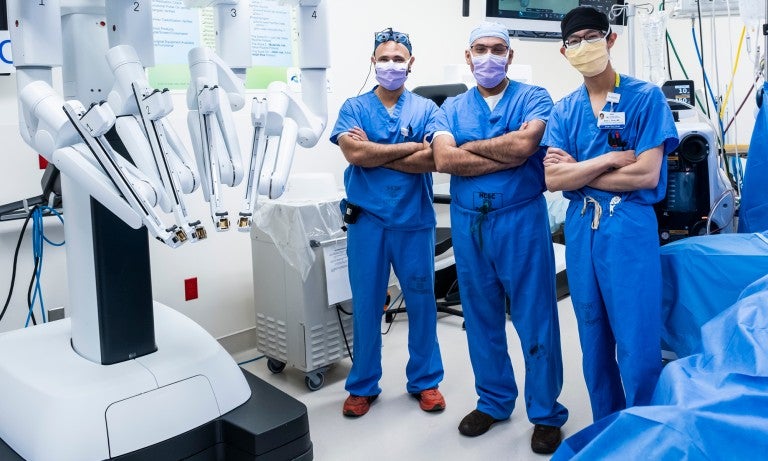
Facing a kidney transplant comes with a lot of questions. The supportive staff at Lehigh Valley Institute for Surgical Excellence will guide you through the entire procedure. We’ll explain how the process works and what to expect, from initial evaluation through transplantation and postoperative care.
At Lehigh Valley Institute for Surgical Excellence, you’ll benefit from a transplant success rate well above the national average. Also, based on biannual SRTR (Scientific Registry of Transplant Recipients) reports, time on our wait list is significantly lower than at other centers.
Why do people need kidney transplants?
People who need kidney transplants have end-stage renal disease, are on dialysis or their kidneys are functioning at less than 20 percent of capacity. Most transplant recipients have kidney disease because of long-term chronic diseases such as diabetes or high blood pressure.
Many kidney transplant patients receive transplants from live donors, and we will assist in the search process. For a kidney transplant, the average hospital stay is five days.
Why do people need pancreas transplants?
Most pancreas transplants are done to treat type 1 diabetes. While a pancreas transplant offers a potential cure, the procedure is reserved for those with serious complications of diabetes. A pancreas transplant often accompanies a kidney transplant when the kidneys have been damaged by diabetes.
The pancreas transplant process mirrors the kidney transplant process. However, there are different types of pancreas transplants, including simultaneous kidney-pancreas transplants. A pancreas transplant requires a longer hospitalization than a kidney transplant as it is a more complex surgery.
How do I get referred to the Lehigh Valley Health Network (LVHN) transplant program?
You can self-refer to the LVHN transplant program using this form, or a nephrologist or dialysis center can refer you. In the latter case, the specialist will complete the form for you.
The IOTA Model beneficiary notification
The kidney transplant program at Lehigh Valley Hospital–Cedar Crest participates in the Centers for Medicare & Medicaid Services (CMS) Increasing Organ Transplant Access (IOTA) Model, aiming to increase access to lifesaving transplants for patients living with end-stage renal disease and reduce Medicare expenditures. More information is available in English or español.
Frequently Asked Questions From Transplant Candidates
Transplant candidates who register at the Institute for Surgical Excellence receive kidneys much faster than at other programs in this region of the country. We also maintain a transplant success rate well above the national and regional norms with a 94 percent success rate for kidney transplants. Register at the region’s only transplant center to spend less time waiting and more time living.
First, you will need to be evaluated by our health care team. Some basic criteria include being healthy enough for a transplant and identifying other health problems that could affect the success of a kidney transplant.
Compared to dialysis, a kidney transplant is typically the better treatment option for kidney failure. A kidney transplant offers you better health, a longer life expectancy, as well as a better quality of life.
After your kidney transplant, you will be on anti-rejection medications for the rest of your life. However, you can live a more normal life as compared to dialysis, where you are committed to many hours a week for treatments.
At LVHN, we will partner with you to make this important decision. You will undergo a thorough evaluation to see if you are a potential kidney transplant candidate. You will meet with our transplant team, which includes a nephrologist, surgeon, nurse coordinator, social worker, dietician, pharmacist and financial coordinator. We are committed to offering the best care and treatment decision for you.
Everyone must be evaluated for appropriateness for transplant candidacy, and not everyone will be placed on the transplant waiting list. You may not be healthy enough for a transplant or have other problems which limit your candidacy. Determining if you are a candidate for any organ transplant requires a comprehensive evaluation, beginning with a medical record review, and the process often includes additional medical testing. Beyond the initial indicators, all patients must be fully evaluated by the transplant team to determine if transplantation is the best treatment option.
Potential transplant candidates include:
- Patients with end-stage kidney disease on dialysis.
- Patients with advanced chronic kidney disease (stage 4 or 5 with calculated or estimated GFR <20ml/min).
- Patients with chronic kidney disease (stage 4 with GFR <30ml/min) who also need another organ transplant.
- Patients with chronic kidney disease who have type 1 diabetes that has not responded to medical treatment may also be considered for a combined kidney-pancreas transplant.
Lehigh Valley Health Network, part of Jefferson Health, is committed to the fair, equitable, and non-discriminatory evaluation of all patients referred for kidney transplantation. In accordance with federal requirements, our transplant center uses written patient selection criteria to determine each patient's suitability for placement on the kidney transplant waitlist and for transplantation.
Every patient referred for kidney transplantation undergoes an individualized, comprehensive evaluation by our multidisciplinary transplant team. Final decisions regarding waitlisting are made on a case-by-case basis, balancing medical, surgical, and psychosocial factors to ensure the best possible outcome for each patient.
Eligibility Criteria for Waitlisting
To be considered for placement on the kidney transplant waitlist, a patient must meet at least one of the following kidney function criteria:
- A qualifying estimated glomerular filtration rate (eGFR) of 20 mL/min or less, or
- A clinical requirement for chronic maintenance hemodialysis.
Meeting a kidney function criterion above initiates eligibility for evaluation, however it does not by itself guarantee waitlist placement. Each candidate is also assessed for surgical fitness, absence of active contraindications to transplantation, ability to tolerate immunosuppression, and adequate psychosocial and adherence support, as determined through the full evaluation process.
Absolute Contraindications
The following conditions generally preclude kidney transplantation. Patients with these conditions will not typically be placed on the transplant waitlist:
- Active or metastatic malignancy. Patients with active cancer (other than certain indolent or low-grade cancers) are not eligible for transplantation. Patients with a prior cancer history may become eligible after an appropriate cancer-free interval, which varies by cancer type and stage.
- Active, untreated infection that cannot be effectively controlled prior to transplantation.
Relative Contraindications
The following conditions do not automatically exclude a patient from transplantation but require careful evaluation, optimization, and individualized risk-benefit assessment by the transplant team. Transplantation may be deferred until these conditions are adequately managed:
- Morbid obesity. Patients with a BMI ≥ 38 kg/m² is a relative contraindication and will be evaluated on a case-by-case basis. Body habitus is assessed individually by a transplant surgeon.
- Active substance use disorder that affects decision-making or places the candidate at unacceptable post-transplant risk. Patients are encouraged to engage in treatment and demonstrate sustained recovery before being reconsidered.
- Unstable or poorly controlled psychiatric illness that impairs decision-making capacity or places the candidate at unacceptable post-transplant risk. Patients are encouraged to achieve stability with appropriate treatment before being reconsidered.
- Demonstrated nonadherence to medical recommendations despite education and adherence-based counseling, which places the transplanted organ at risk.
- Prior cancer history. Patients with a history of treated cancer may be eligible after an appropriate cancer-free waiting period, which varies by cancer type and stage (ranging from no waiting time for certain low-risk cancers to five or more years for higher-risk malignancies). Decisions are made collaboratively with the patient's oncologist.
- Active symptomatic cardiovascular disease (e.g., unstable angina, uncontrolled arrhythmia, symptomatic heart failure, uncorrected valvular disease, symptomatic peripheral arterial disease) that has not been fully evaluated and optimized by a cardiologist.
- Active gastrointestinal conditions such as symptomatic peptic ulcer disease, acute diverticulitis, acute pancreatitis, symptomatic gallstone disease, acute hepatitis, or active inflammatory bowel disease might be deferred until these conditions are treated and resolved.
- Inadequate social support. Patients without current social support may still be considered if they are able to care for themselves and have an identified support plan in place prior to transplantation.
Important Notes
- The presence of a relative contraindication does not mean a patient cannot receive a transplant. Many of these conditions can be treated, managed, or optimized so that the patient may safely proceed with transplantation.
- Patients who are not approved for waitlisting will be informed of the specific reason(s) for the decision and are encouraged to seek a second opinion at another transplant center.
- Candidacy decisions are reviewed periodically, and patients whose conditions improve may be reconsidered for transplantation.
After kidney transplant, 94 percent of transplanted kidneys are functioning. The recovery process is different from person to person.
We strongly recommend that you stop using nicotine products. You may be required to quit based on your medical history and other factors. Active consumption of nicotine products could prolong the start of the evaluation process in determining eligibility.
We are here to support you with your effort to quit. LVHN offers a smoking cessation group and we would be happy to refer you to this resource. If you feel that you may require additional supports, we encourage you to contact your family doctor to discuss medications and other options to aid in the goal of discontinuing nicotine dependence. Smoking cessation aids such as nicotine gum, lozenges or patches are great ways to manage withdrawal symptoms. However, keep in mind that you will be tested on all nicotine in your system, so you will also need to stop these aids before your transplant. It is our goal for your transplant to be successful. In order to do so, it is crucial to reduce as many risk factors as possible to ensure safety.
If you are approved for a kidney transplant, you will be placed on the waiting list. In this region, our wait-list time is 3-4 years, so it’s important to be evaluated early – as soon as kidney function is less than 20 percent of normal. During your time on a wait list, you can begin searching for a suitable living donor.
You must be on the transplant list to receive a kidney transplant, regardless of the type of donor. You have the right and the ability to be on wait lists at multiple transplant centers in the U.S.
Most people are born with two healthy kidneys, and only one is required to live. Potential living donors are thoroughly screened to make sure it is safe for them to be a donor. There are also benefits to living donation:
- Planning a surgery time that is convenient for both of you.
- Recovery time for you may be shorter.
- Kidneys from living donors often result in better outcomes.
You should let friends and family know about your transplant needs. People receiving a kidney from a living donor have better outcomes than those receiving one from a deceased donor. Living donors must be between 18-75 years of age and in good health.
Not everyone who needs a transplant is medically suitable to have a living donor kidney. They may have a complicated medical or surgical history or be too high of a risk. More than half of LVHN transplants are from a deceased donor.
What if I don't have a living donor? Will I still be on the list?
Yes, the waiting list is for candidates waiting for a kidney from a deceased donor. A deceased donor is someone who has died, usually from a severe brain injury.
Are all deceased donors the same?
No, every donor is different: Different ages, genders, ethnicities, some with prior diabetes or high blood pressure, each with different levels of kidney function. Much of this information is summarized in the Kidney Donor Prognostic Index (KDPI). The KDPI scale is in a percent from one, the best donor, to 100, not a good donor. We only offer kidneys from donors with KDPI greater than 85 percent to those who have agreed to receive offers from these donors.
Will you tell me anything about the donor?
We are obligated to keep the donor anonymous, so there is very little information we can share with you. However, when you get called with an organ offer, if you have consented to receive offers of KDPI greater than 85 percent donors, we will tell you which category the donor falls into, KDPI less than 85 percent or greater than 85 percent. Most high KDPI donor kidneys will have a biopsy performed to look for how well we hope the kidney will function, and we will share this biopsy result with you.
I have heard about people accepting organs from donors who have done IV drugs or who overdosed. Is this true?
Yes, this is true. In general, illicit drugs, while they have lots of bad effects, do not damage the kidneys or impair kidney function. Medically, our concern for donors who use illicit drugs is the risk of the donor kidney transmitting a viral infection like hepatitis to a transplant recipient.
For any organ offer, we will tell you if the donor meets so-called risk criteria, meaning that the donor has engaged in some type of behavior that increases the donor's chance of acquiring a viral infection. All donors are tested by a very sensitive test for many infections including hepatitis B, hepatitis C, HIV and COVID. You'll be told of any test that is not completely negative, and what the test result means.
The risk of acquiring a viral infection from a transplant is very, very low, but can never be zero. For the riskiest type of donor, which is a donor who died after injecting drugs intravenously, the risk of acquiring a viral infection is less than 1 in 1000. However, all donors carry a risk of disease transmission. Viruses, bacterial infections and cancers have been transmitted to recipients. These are rare events, and more importantly, the risk of dying on the wait list is much higher than contracting a disease from the donor.
We encourage any donor who is not a match for their intended recipient to be enrolled in the kidney exchange program. A kidney exchange program matches donors with appropriate recipients. If you want to be a donor but know you are not a match for the person you wish to donate to, we will find you a match for your kidney and in exchange we find a donor who matches your intended recipient.
While waiting for a kidney transplant, maintaining a healthy weight with proper nutrition decreases surgical complications and helps your recovery after surgery. Before your kidney transplant, you will need to follow a renal diet as recommended by your nephrologist. After your kidney transplant, these dietary recommendations will change. However, the goal remains the same: Maintaining a healthy weight with proper nutrition will keep your transplanted kidney working longer. A dietitian will work with you throughout your transplant journey.