Image



Hand-foot-and-mouth disease is disrupting day cares, schools and even football teams
It may be known to peak during summer and fall, but hand-foot-and-mouth disease (HFMD) is fair game any time of year. It’s a virus so there’s no medication for it, and it’s highly contagious, especially in settings such as schools and day cares.
Oddly enough, it’s on the rise. In some U.S. states, the incidence of HFMD has doubled since 2023.
“The day cares in the Lehigh Valley are on top of it,” says certified registered nurse practitioner Travis Green, with Lehigh Valley Reilly Children’s Hospital. “If one child starts with it, they are taken out. Sometimes parents send their children in with HFMD because they can’t see it. If it hits a day care, it can spread rapidly.”

HFMD is completely different from foot-and-mouth disease (or hoof-and-mouth disease), which is a disease of farm animals. You can’t catch the human one from animals or spread it to them.
Common in children younger than 5 years old, HFMD can affect people of any age. “Just last year, we had a whole football team get it,” Green says.
Kids are contagious for seven to 10 days, but the virus can continue to be active in a child’s gastrointestinal tract for four to six weeks. Some people, especially adults, can pass the virus without ever showing symptoms. Otherwise, symptoms appear within three to six days after infection.
Symptoms often start with a fever, sore throat and body aches. Young children may lose their appetite. Infants might be extraordinarily fussy. A few days after the fever begins, a rash of painful blisters or bumps can pop up.
“The rash develops inside and around the mouth, on the hands, feet, buttocks and potentially the genitals,” Green says. “Parents sometimes think it’s diaper rash. But if you see it in a couple of those places, it’s most likely HFMD.”
Day care policy is that when children are fever free for 24 hours, blisters have scabbed over and no new rash has appeared, they are safe to return to day care or school. However, Green notes day care staff should keep in mind the disease can still spread through feces for a few weeks.
With no specific medication to attack HFMD, parents must resort to supportive care to ease their children’s pain and discomfort. Green says over-the-counter pain control is one way to provide relief.
“Sometimes a child’s mouth will be so sore they don’t want to drink,” he says. “Parents need to push the fluids and pain medication, so they do not become dehydrated.”
Children as young as 2 months can take acetaminophen for pain, and ibuprofen can be given at 6 months. Green says parents should be sure to read labels, since there are specific dosing recommendations.
For mothers who are breastfeeding, Green recommends pumping instead. “Other than that, wash your hands a lot, avoid sharing food and drinks, and – unfortunately – avoid kissing.”
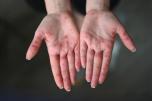
Prevention comes in the form of cleanliness, since the disease spreads by way of saliva, stools, respiratory droplets and discharge from blisters.
Hand washing and disinfection of surfaces are the best defense. Parents also recommend putting socks on children’s hands to prevent spreading, and to try to keep siblings separated. Any method of prevention is wise, because children can get reinfected.
“HFMD is not something you can become immune to,” Green says. “We have children who have it and get it again two weeks later, because there are many different strains. Some are not as severe while others make you so sick, you can have a full-body rash.”
Green mentions another consequence of this strange disease.
“About four to six weeks after you have HFMD, your fingernails can peel,” Green says, adding that this will eventually resolve itself. “No illness is fun, but this one seems to freak parents out.”