Image



They use all their tools to make children feel at home


Even adults can be overwhelmed by the prospect of a medical procedure or an inpatient stay in the hospital. Imagine how kids feel.
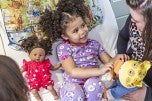
The child life program at Lehigh Valley Reilly Children’s Hospital helps children adjust and be more comfortable with clinicians, tests, surgery and everything in between.
Child life specialists, who become “child life” certified beyond their primary degree, partner with doctors, nurses, social workers and other members of a care team to meet the unique needs of children and their families. As experts in child development, they know how to help kids cope with a visit to the hospital along with a lot of other situations related to medical care.
“The idea is a sense of normalization by doing what the child might be doing outside the hospital, as well as focusing children’s social, emotional and intellectual growth,” says child life specialist Lisa Makhoul. “We offer opportunities for stress relief and relaxation as well as distractions to make procedures or medical events easier.”
Makhoul, who earned an LVHN Friends of Nursing Award for Excellence in the Promotion of Patient Care in 2023, explains that when people are under stress, as many families are during a health care event, it’s difficult to understand what is going on. The child life specialist steps in as a calming force, explaining what to expect and what the medical team will be doing.
“Our work might involve explaining that an IV has to stay in for a while, easing fears about an unwanted hospital stay or prepping a child who is, for the first time, seeing a parent who was in a car accident,” Makhoul says. “There can be shock and a lot of stress related to ambulances, procedures, missing work – there are so many layers. We have to be comfortable with what’s uncomfortable all the time.”
A small, dedicated team of child life specialists at LVHN cover emergency, inpatient pediatrics and the pediatric intensive care unit, the outpatient infusion center, outpatient hematology and oncology, gastroenterology, radiology and the Regional Burn Center. About 30,000 children pass through the children’s ER at Lehigh Valley Reilly Children’s Hospital alone and the unit is open 24 hours a day, seven days a week. That offers a look at how many patients the child life specialists serve.
“We are a small but mighty team, and we absolutely have to be chameleons,” Makhoul says. “We need to blend into different nursing styles, with different doctors and maintain good communication with the clinical staff as well as the families. That’s really a big part of being successful. That and being good at distraction.”
Makhoul relates a story about a baby that had come into the ER with croup, and she was having difficulty breathing. The child was so upset, it was difficult for the nurse to even obtain her blood pressure and heart rate. “In this case, we used bubbles, right at the bedside,” says Makhoul, who notes she is sometimes an improv comedian, or she verbally distracts with tons of questions in addition to carrying a bag with all kinds of toys and tools. “The bubbles caught the baby’s attention, and she became less distraught,” she says.
At the same time the child life specialists are helping children, they’re also helping parents and the children’s siblings. They assist with simple things such as how to navigate the hospital or with big things like guiding parents as they tell their children that one child has been diagnosed with cancer or has died.
“One thing we never do, is tell children not to cry,” Makhoul says. “We assure them we cry when we’re sad too.”