Image



How this active family of 11 copes with the help of the Hemophilia Treatment Center at LVHN


Kids are bound to get injured occasionally. Maybe they get hit by a lacrosse stick or fall off their skateboard. For most people, it’s a matter of antiseptic and a bandage. However, for those who have von Willebrand disease (VWD), a condition that keeps the blood from clotting, a small incident can be serious and frightening.
“My 17-year-old son is prone to nosebleeds, which, for us, can be life changing,” says Danielle Ford, a Macungie resident whose husband, Matthew, and four of her nine children have VWD. “There's always a chance we would have to cancel all our plans, and our son could end up in the hospital. It has happened before, but he's gotten good at reacting immediately and effectively. While the disease doesn’t cause his nose to bleed, it can make it much more significant.”
The disease also promotes bruising, including bruises that turn black on the face. “I’ve had to explain my situation to a friend who works in child services,” Ford says.
“Von Willebrand disease is a common bleeding disorder that runs in families,” says Bradley Lash, MD, with LVH Hematology Oncology–1240 Cedar Crest. “It is generally mild but can be life threatening. The condition is monitored by our hematology team since patients need lifelong treatment for bleeding and special care prior to surgical procedures. We provide ongoing follow-up so patients can live normal lives.”
Because it’s important to Ford that her family “lives a normal life,” she stays on top of her children’s activities and lifestyle so she can jump in if necessary. They are active in sports, which adds another level of caution. However, with the help of Lehigh Valley Health Network (LVHN) and its Hemophilia Treatment Center, the children have been successful in pursuing their interests with enthusiasm.
“The biggest challenge is deciding what to do when you experience some trauma, such as in sports or riding your bike,” says J. Nathan Hagstrom, MD, Chair, Department of Pediatrics with Lehigh Valley Reilly Children’s Hospital. “For the family, it’s ‘Do we wait and see how it goes? Do we call the doctor? Go to the ER?’ For the clinician, we’re deciding what treatment to prescribe. It’s as much an art as it is a science, which is why people with bleeding disorders need an experienced team like we have at the Hemophilia Treatment Center,” he says.

The Fords’ diagnosis of type 2A means there is not enough von Willebrand factor (vWF), a protein essential for blood clotting. For minor incidents, like some nosebleeds, Ford can administer medication at home. One treatment is a pill, which strengthens blood clots once they form, and another is a nasal spray, which contains a small molecule that triggers the release of vWF.
“The nurses and staff are phenomenal. They are always available and never give me a hard time even if I have a dumb question. If I have concerns, I call, and they listen. Sometimes it’s just a matter of reassuring me that it’s OK. Or they let me know if I should bring my child in.” – Danielle Ford
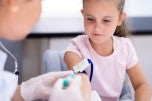
For more serious incidents, Ford’s husband and her children must go to the hospital for an infusion, which may need to be repeated multiple times over days or weeks. This was the case for Ford’s youngest son, Isaac, who split his frenulum – the line of tissue that runs from the gums to the upper lip – and spent days in and out of the hospital. Dr. Lash notes, “Part of the treatment includes helping the person with the impact a bleeding disorder has on one’s life and supporting them in managing the complications specific to their needs.”
“The foundation of effective management in patients with von Willebrand disease is education and promotion of self-advocacy,” says Jennifer Ngo, a certified registered nurse practitioner with the Hemophilia Treatment Center. “Recognizing early signs of bleeding and understanding appropriate use of factor products are critical. In addition, creating a clear emergency bleeding plan ensures the best care.”

In Ford’s opinion, her family has received exceptional care at LVHN for more than 18 years.
“They understand how important it is for these kids to have their lives,” Ford says. “The doctors have real conversations with my children and assure them they will make this work. They have sent so many letters and notes to teachers, coaches and school administrators. Those are the things that take time but make my children’s lives better.”
Dr. Hagstrom agrees that major efforts have been made on both sides. “Fortunately, for the Fords, the disease doesn’t slow them down. They live a normal life and do normal things,” he says.