Image



Ronald Ramsey is grateful for his second chance thanks to LVH–Muhlenberg surgeons
Ronald Ramsey’s job was fixing complex missile launch systems on Navy destroyers.
In May 2025, trauma surgeons at Lehigh Valley Hospital (LVH)–Muhlenberg, part of Jefferson Health, had the complex job of fixing him, saving his life from the effects of a bullet to his chest that seriously damaged his left lung.
Ramsey, 57, suffered the injury at home in Danielsville, Northampton County, but has no memory of how he came to be shot. He says his wife and son were in another part of the home at the time, heard the gunshot, found him, and called 911. “I don’t remember any of it,” Ramsey says. “I only remember waking up three and a half weeks later in the intensive care unit.”
Trauma surgeon Charles Proctor, MD, says Ramsey was having trouble breathing but was awake when he came into the LVH–Muhlenberg emergency room, a Level II trauma center. Dr. Proctor wasn’t on duty that day, but was at the hospital for the 2025 Trauma Survivor’s Day ceremony. He scrubbed in to assist fellow trauma surgeon Priyal Patel, MD and others aiding Ramsey.
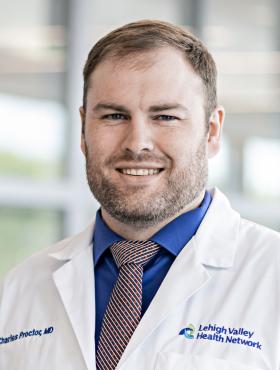
Ramsey was placed on a ventilator and rushed into surgery. “We had to track where the bullet went,” Dr. Proctor says. Cardiothoracic surgeon Jeffrey Veluz, MD, also assisted and finalized work to stop the bleeding.
While Ramsey, now retired, ended up losing 20 percent of his left lung, the rest of that lung was saved and more importantly, he survived. “We initially thought we might have to take the entire lung,” Dr. Proctor says.
Nurse practitioner Alison Bruce was at Ramsey’s head in the trauma bay and says it was “all hands on deck.” She says Ramsey asked her to tell his wife he loved her. “I said you’re going to tell her,” Bruce recalls.
“The effort was impressive. There were multiple surgeons and specialties in the emergency room and operating room. There was maximal effort and without it, he would not have survived.” - Charles Proctor, MD
Dr. Proctor says Ramsey’s recovery was a very long process, initially involving feeding and breathing tubes. “He was touch and go from a pulmonary (breathing) standpoint for some time,” he said.
Ramsey’s tenuous medical situation required the use of specialized breathing equipment to get enough oxygen into his bloodstream, says Dr. Patel. Because pressure from a more standard ventilator could damage the lung, doctors used a volume diffusive respirator (VDR). The VDR provides repetitive but short bursts of pressure to force oxygen into the lungs without damaging the lungs to the point of bursting.
“There are a limited number of machines in the country, but it also requires special training to control and our respiratory therapy team, along with the ICU team, have that expertise,” Dr. Patel says.
Ramsey’s survival chances were low, Dr. Proctor says. “The effort was impressive. There were multiple surgeons and specialties in the emergency room and operating room. There was maximal effort, and without it, he would not have survived. He could have died, but didn’t, and that’s nothing short of astounding.”
Ramsey says his long ICU stay left his body very weak, and he praised the efforts of physical and occupational therapists who got him back on his feet and relearning basic tasks. Standing and walking were difficult at first, but Ramsey says he constantly pushed himself to do more. He says he’s normally a positive person and believes that helped keep him motivated.
“You never think at 57 you’re going to be relearning everything, even holding silverware,” he says. “My cell phone felt like a 10-pound brick.”
Ramsey says he’s also grateful for the support of his entire family, including his wife Christine and their five adult children, during his hospitalization and recovery.
One of Ramsey’s favorite things is watching Fourth of July fireworks displays from his deck at home. His vantage point allows him to see fireworks shows from some surrounding communities. He set his sights on getting home in time to enjoy that tradition.
He hit his goal, getting back home July 3, 2025.
As he reflects on his ordeal, Ramsey remembers all who took care of him, from the ER, to the ICU, to inpatient rehabilitation. “They were all good people,” Ramsey says.
Before he left the hospital, Ramsey went back to see nurses and others who had cared for him. “They said ‘Nobody ever comes back to thank us’,” he recalls. “I remember hugging each one of them and thanking them for keeping me alive. It brought tears to my eyes.”
Ramsey says he’s 95 percent back and his 6-foot-4-inch frame is back to its usual weight. Weightlifting and walking are part of his weekly routine. He’s back to gardening and riding his motorcycle and intends to start golfing again.
On a day when the odds were stacked against him, Ramsey prevailed. His surgeons and their fellow clinicians, aided by expertise, leading-edge facilities and a spirit that left no stone unturned, helped turn the tide.
Bruce says she sat with Ramsey's wife while he was in the operating room. “He’s a phenomenal person to come through this and to be doing as well as he is now,” Bruce says.
“I’m thankful for their abilities and their knowledge,” Ramsey says. “I think they went above and beyond. By their hands, I am still here.”