
Liver Cancer
Your liver is a football-sized organ that sits in the upper right portion of your abdomen. When the liver becomes damaged, the entire body can be affected. Liver disease is a term that includes a range of conditions and diseases including cancer. Liver cancer happens when cells in this area start growing out of control.
The Cancer Institute offers sophisticated cancer treatments, including robotic surgery and the latest chemotherapy drugs, giving you the best chances for good results.
What are the symptoms of liver cancer?
In the early stages, liver cancer usually doesn’t cause symptoms. As the cancer grows, it interferes with the liver’s ability to do its job, causing symptoms such as:
- Feelings of fullness after eating just a little food
- Abnormal bruising
- A tissue mass under your ribs on the right side, which could mean liver swelling
- Jaundice, which causes yellowing of the skin or eyes
- Changes in chemical messengers (hormones) that can lead to swollen breasts in women and other problems
Liver cancer tumor board
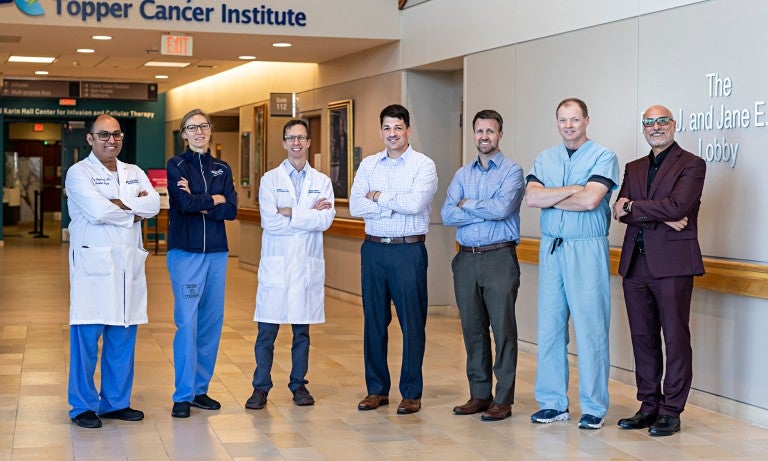
If you’ve been diagnosed with liver cancer, your situation may present complex clinical challenges requiring a highly individualized treatment approach. The Cancer Institute's liver cancer tumor board brings together a diverse team of specialists to consult on diagnosis, staging and therapeutic decision-making. They ensure you are offered all viable options and that therapies are integrated seamlessly for the best outcomes. Experienced staff specialists from eight areas discuss cases and, together with you, decide on the best plan for liver cancer treatment.
The board includes:
- Hepatologists, who optimize liver function, manage cirrhosis-related complications and assess you as a candidate for a transplant or surgery.
- Medical oncologists, who guide therapy options, including chemotherapy, immunotherapy and targeted therapies.
- Surgical oncologists, who assess the ability of the tumor to be removed and coordinate the surgeries, including potential implantation of a hepatic artery infusion pump (HAIP), which delivers chemotherapy directly to the tumor.
- Radiation oncologists, who contribute radiation expertise in approaches such as stereotactic body radiotherapy, especially in cases where surgery is borderline or not possible.
- Radiologists, who interpret imaging in detail for accurately staging the tumor as well as for treatment and assessing response.
- Interventional radiologists, who offer novel therapies such as histotripsy, a nonsurgical liver cancer treatment that utilizes focused ultrasound to destroy cancer cells.
- Pathologists, who ensure diagnostic accuracy and molecular profiling, when needed.
- Liver transplant surgeons, who evaluate your eligibility for a transplant, especially if you have hepatocellular carcinoma, the most common form of liver cancer that starts as a growth of cells in the liver.
Treatments for liver cancer
At the Cancer Institute, you don’t have to wait to start healing. Our multidisciplinary clinic helps you learn about the cancer treatment options that are right for you. In one visit, you see multiple experts, including a surgical oncologist, radiation oncologist and medical oncologist, and have the support of a nurse navigator. Read more about our multidisciplinary cancer clinics. Your care may include:
Cancer drugs (chemotherapy)
We deliver a personalized combination of drugs that halt cancer growth. Our participation in prestigious clinical-trial networks gives you access to new technology and chemotherapy drugs that are not widely available. For example, some people can benefit from targeted chemotherapy to their liver through a hepatic artery infusion (HAI) pump.
Radiation therapy
We consistently deliver effective radiation therapy treatments with an unwavering focus on your safety. Our commitment to high care standards has been consistently recognized with accreditation from the American College of Radiology.
Selective internal radiation therapy (SIRT) is a treatment approach for primary liver cancer or metastatic colorectal cancer that has spread to the liver. SIR-Spheres® Y-90 resin microspheres are tiny radioactive “beads” used in SIRT, sometimes referred to as Y-90 radioembolization. SIRT treats liver cancer or cancer that has spread to the liver and can’t be surgically removed.
Stereotactic body radiation therapy (SBRT), featuring millimeter precision, targets tumors with very high doses of radiation. SBRT can cure early-stage cancer by destroying the tumor. It can also shrink tumors, stop the spread of disease and even stimulate the body’s immune system to fight cancer.
Histotripsy
Histotripsy is a highly innovative treatment approved by the U.S. Food and Drug Administration in late 2023. We are the first in Pennsylvania to offer the technology, which uses ultrasound waves to destroy cancerous tissue at the subcellular level without incisions, radiation or needles. Histotripsy can be applied to various types of tumors, including those in the liver, kidney and other organs. The next closest locations for the treatment are in Camden, N.J., and Rochester, N.Y.
Surgery
The Cancer Institute is home to one of the first surgeons in the country board-certified in complex general surgical oncology. We also use all the latest techniques, including robotic surgery, to remove the cancer while preserving nearby healthy tissue. Find out more about cancer surgery.