Image

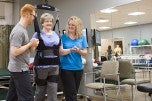
Occupational therapist Blake Day and physical therapist Brianna Hanover


After 24 days with the Inpatient Rehabilitation Center–Muhlenberg, Troy Kern returned home
Troy Kern opened his eyes, unable to move from the neck down. Through the shock, he kept arriving at the same grim conclusion. I’m screwed.
Throughout February 2025, Kern battled the flu. He was taking cold medicine on top of his usual prescriptions for full-body complex regional pain syndrome (CRPS) when he nodded off on his toilet, fell over and slammed his head against the floor. He broke four vertebrae in his neck.
For an hour, no one heard his cries for help.
Thankfully, Kern, 58, a former maintenance mechanic at Victaulic, and his wife, TK, live with his daughter and her family in Danielsville. Grandchildren Malia, 6, and Jett, 4, heard Pop-Pop as they came home from school. An ambulance took Kern to Lehigh Valley Hospital–Muhlenberg.
On Feb. 28, the C4 through C7 vertebrae in Kern’s neck were fused. Afterward, he had some movement in his fingers and toes, but work remained.
When he arrived at Inpatient Rehabilitation Center (IRC)–Muhlenberg in early March, Kern was committed. “Gotta live for the grandkids, man,” he explains. Over 24 days, the team, including occupational therapist Blake Day and physical therapist Brianna Hanover, helped Kern get back on his feet and back to his life.
Kern initially required two people, in addition to an overhead lift, to get out of bed, says Taylor Furry, his rehab clinical specialist. The goals were modest.
“We just went with trying to figure out what kind of adaptive equipment we could use in order to get him to be able to help feed himself or brush his teeth or be able to get his pants on,” Furry says. Another goal was to make sure Kern got out of bed outside of daily therapy.
Spinal cord injuries are challenging from a rehab perspective, Hanover and Day say, because the areas in the body requiring attention can change daily. Kern’s long medical history was another consideration. He was diagnosed with full body CRPS around 2007, but he thinks he had it as early as 2000.
“I never let any negativity in,” Kern says. “That’s the bottom line: You have to be positive.”
Hanover and Day quickly learned that Kern’s work ethic and drive were exceptional. He raced past his goals. Twice, Day and Hanover had to adjust them. Kern went from walking 40 feet with a walker in his second week of rehab to 300 feet a week later. “They kept pushing me, which was great,” Kern says. “I kept telling them, ‘You push me hard.’” He did exercises in his room on his own. That Kern suffers from chronic pain made the effort more remarkable, Hanover says.
“He wanted to make sure that he was able to do things for himself and not have his wife do everything for him when he got home,” Furry says.
By the time he left inpatient rehab, Kern could complete some everyday tasks on his own. He could walk with a single-point cane. When he started, he needed a special call bell. His hands were too weak.
“He really went above and beyond our expectations,” Hanover says.
A successful inpatient rehab stint, Furry says, gets the patient independent enough to go home. Top-flight equipment and the right exercises aren’t enough. The patient must arrive with a good attitude. The therapist needs to know when to push and when to rest, which “comes with experience and interactions with the patients, knowing what works and what doesn’t work,” Day says.
The resources and equipment at IRC–Muhlenberg do little good if the staff doesn’t know the patient’s situation at home, like how the bathroom is set up and how they enter their home. “In order to utilize the resources best,” Day explains, “we really want to tailor that to each patient’s scenario.”
It helped that Kern had a motivation. “Troy had really good family support,” Hanover says. “His wife was here almost every day. His daughters would come in. So, having that factor, too, helped a lot.”
The staff at IRC–Muhlenberg also knows the value of keeping things personal.
“I think that community feel between our treatment team – even with the nurses, physiatry, case management – that really crosses over to patients,” Hanover says. It makes for a better experience for the patient and, Day notes, helps their confidence.
“They were just phenomenal,” Kern says. “They were so friendly.”
He’s now undergoing outpatient therapy at LVHN’s neuro–destination center in Allentown. Whatever comes next, Kern is ready. There is no other way. When you give up, he says, you lose.