Image



We’re committed to educating the next generation of surgeons


It’s important to bring attention to prevention of colorectal cancer. It’s also important to never let up on mastering techniques for colorectal cancer treatment. Ensuring patients have the best chance for recovery is the motivation behind events like the colorectal anastomosis lab that took place at Lehigh Valley Institute for Surgical Excellence, part of Jefferson Health, on March 21, 2026.
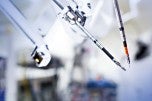
Now enhanced with the most advanced surgical robots across all its campuses, the Institute for Surgical Excellence is helping residents and fellows practice and polish their skills on the new technology. This was the intention behind the March lab. It focused on intracorporeal anastomosis, a complex surgical technique where the reconnection of bowel segments (anastomosis) is performed entirely inside the abdominal cavity using robotic instruments.
“The intracorporeal approach requires greater skill since it is being done using small robotic instruments rather than the surgeon’s hands,” says Bogdan Protyniak, MD, with LVPG Colon Rectal Surgery–Independence Road, East Stroudsburg. He notes that the newest robot is an asset because it offers better visualization, instrument dexterity, simulates the sense of touch and outlines the position of instruments on the screen for the first assistant, promoting safety.

“All of this can improve the learning curve for surgeons adopting these new techniques,” he says.
While these features benefit surgeons and staff, patients benefit even more. Studies involving robotic colorectal surgery for anastomosis have shown fewer postoperative complications, less blood loss, smaller incisions, a lower incisional hernia rate, faster bowel recovery and shorter hospital stays.
The anastomosis lab began with an hour-long educational session covering two distinct, commonly performed partial colectomies (a right hemicolectomy, or removing the ascending colon, and a sigmoidectomy, removing the lower, S-shaped sigmoid colon). These procedures are for taking out diseased sections of the colon, typically due to cancer, polyps or inflammatory bowel disease.
Attendees spent the remaining three hours in the operating room, utilizing two state-of-the-art robots. Residents and fellows had the opportunity to perform colorectal intracorporeal anastomoses on a synthetic intestine model, simulating the look and feel of a human intestine.
“This is a great way to illustrate that we aren't just focusing on colorectal cancer screenings,” Dr. Protyniak says. “We’re teaching the next generation of surgeons how to take care of these patients utilizing the latest technology with better outcomes.”
Besides enabling accuracy, the newest robots utilize a first-of-its-kind “tactile” technology. This allows the surgeon to sense push-and-pull forces and feel tissue tension in common tasks such as dissection, retraction and suturing. It results in up to 43% less force on tissue, making the new robot the most minimally invasive yet.
Further precision is made possible by advanced instruments. The human hand inspired the design of graspers and other instruments; however, they offer a greater range of motion than hands to extend the surgeon’s capabilities. The surgical tools mimic and magnify the surgeon’s movements, seamlessly adjusting hand-to-instrument ratios. The system also reduces the natural tremor inherent in humans, so surgical teams can feel confident conducting extraordinarily complex procedures.