Image



Clinical trial shifts ‘simply curing the disease’ to also protecting quality of life after treatment


Since he had no symptoms, former accountant Jim Whited – an avid cyclist and musician – opted for an at-home stool test to screen for colon cancer. To his surprise, the test was positive, so he followed up with a colonoscopy. Imaging results showed locally advanced rectal adenocarcinoma (cancer) as well as prominent lymph nodes.
“At first, I was frightened,” Jim, 71, says. “But then I thought it through. I had CT scans and they didn’t show cancer anywhere else. I knew that I’d get through it, and that gave me peace.”
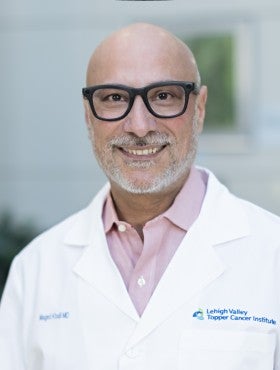
Some of Jim’s peace of mind came from meeting with his gastrointestinal oncologist Maged Khalil, MD, Associate Director of Research, Lehigh Valley Topper Cancer Institute, part of Jefferson Health, along with radiation oncologist Alyson McIntosh, MD, and colon-rectal surgeon Kristen Halm, MD. Highly experienced in cancer treatment, they assembled the Cancer Institute Tumor Board and the clinical trials team to discuss the case.
The experts recommended Jim for one of the National Cancer Institute-supported clinical trials available at Lehigh Valley Topper Cancer Institute, testing a newer chemotherapy intensification approach.
This involves “watch-and-wait,” nonsurgical management, where patients are monitored very closely with regular MRI scans, endoscopic exams and clinical evaluations. When clinicians carefully select and monitor patients, this approach can preserve the rectum, maintaining normal function without compromising cancer outcomes.
“Even when patients with rectal cancer respond to chemotherapy and radiation, traditionally, they would still have surgery to remove the rectum,” Dr. Khalil says. “While effective, this operation can have lifelong effects, including changes in bowel function and, in some cases, the need for a permanent colostomy.”
Dr. Khalil says this caused researchers and clinicians to ask, “If the cancer appears to be gone, is major surgery always necessary?”
Jim’s treatment began with five weeks of radiation therapy given together with an oral chemotherapy drug. After completing radiation, as part of the clinical trial, he went on to receive four months of intravenous chemotherapy for a total of eight cycles. His team says he tolerated the treatment well.
“Jim and his wife, Maureen, liked to tell me about their adventures and how they enjoy retired life with their family,” says Amber Busher, Clinical Research Coordinator with the Cancer Institute. “Jim is a kind man who was put into very challenging circumstances, but his positivity has remained strong throughout his journey.”
When Jim finished therapy, “An MRI scan of the rectum, a direct examination and a sigmoidoscopy all showed no evidence of remaining cancer,” Dr. Khalil says.
“I was able to clear Jim for our careful watch-and-wait surveillance program, which includes regular scans, scopes and laboratory tests, but no surgery,” Dr. Halm says. “He was definitely happy about that outcome.”
By summer 2025 with “no evidence of disease,” Jim was able to spend more quality time with his wife, two children and four grandchildren. He returned to his favorite activities, including bike rides, playing music in a band with his friends and singing in two choruses.
“Dr. Khalil went above and beyond. He saved my life at least twice,” Jim says, recalling the doctor’s extra vigilance regarding Jim’s lymph nodes and an incident with blood clotting. “I couldn’t get over how kind and caring everybody is. They really listen and are completely engaged.”
Jim’s brush with rectal cancer has been a wake-up call toward staying active and not wasting a moment of time. “I’m loving life,” he says.