Image



Chris Ulmer beats prostate cancer with radiation-free, high-intensity focused ultrasound


When it came to his chances of developing prostate cancer, the genetic odds were stacked against Chris Ulmer.
His likelihood of developing the disease was up to five times higher than normal because of his immediate family’s cancer experience. His father had prostate cancer and his paternal grandmother had breast cancer.
Attentive to his health, Chris always got regular medical checkups. As he grew older, his prostate specific antigen (PSA) score began to rise. PSA is a protein made by the prostate and its level is measured through a blood test. Chris says he began monitoring his PSA levels in his late 40s and early 50s. But when his PSA score jumped several points to just over nine, he was advised to see a urologist and selected Lehigh Valley Physician Group (LVPG)–Urology.
Historically, a PSA level of four is considered the maximum for a normal result, but every man’s circumstances and genetic history normally make for a more nuanced approach to monitoring. Doctors also look at PSA levels over time. A higher PSA level does not automatically mean prostate cancer because there can be other causes for an increased number, such as benign prostate enlargement or a urinary tract infection or irritation.
The National Comprehensive Cancer Network advises starting PSA testing discussions with your doctor around 45, and sooner if, like Chris, you have risk factors such as a close genetic relative who had the disease.
A biopsy last year confirmed Chris, 62, of Lower Milford Township, Lehigh County, had prostate cancer. “Obviously, it wasn’t a total shock to me,” he says. “I was already anticipating that at some point, I might develop it.”
A variety of scans showed no cancer elsewhere in his body.
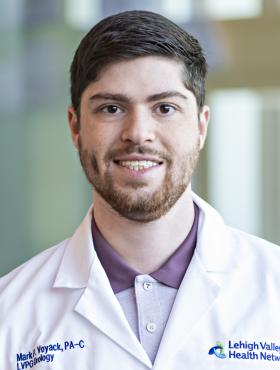
Through LVPG Urology, Chris discussed his options with physician assistant Mark Voyack. One of his choices was robotically assisted, noninvasive, high-intensity focused ultrasound (HIFU).
“HIFU is a great additional option, for the right candidate, outside of radiation or complete removal of the prostate,” Voyack says. “For patients, this can mean all the difference to them. At the end of the day, they want their cancer treated without side effects.”
Voyack says Lehigh Valley Health Network (LVHN), part of Jefferson Health, having HIFU as an option for men with prostate cancer shows the health network is at the forefront of cancer care and dedicated to the people it serves.
HIFU is one of several prostate cancer treatment options under an umbrella known as focal therapy.
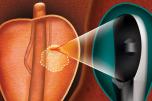
Offering a low occurrence of side effects such as incontinence or erectile dysfunction, HIFU uses an ultrasound probe to scan your prostate and deliver high-intensity sound waves to a targeted area — similar to how a magnifying glass can focus light rays to burn a leaf.
The probe is inserted into the rectum and doesn’t require an incision. The magnitude of ultrasound energy delivered rapidly raises the temperature at the focal point, causing cell damage and cell death, without damaging healthy tissue and structures outside the targeted area.
HIFU, approved by the Food and Drug Administration for use in the U.S. since 2015, isn’t for every prostate cancer patient.
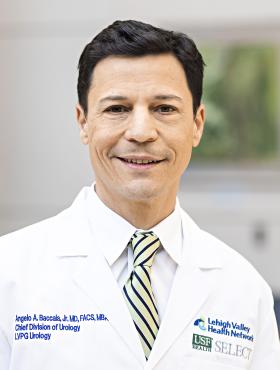
Much depends on the size and location of the cancer, says Angelo Baccala, MD, Chief, Division of Urology, and Deputy Physician-in-Chief for Lehigh Valley Institute for Surgical Excellence. Dr. Baccala performed Chris’ HIFU procedure in June 2025 at Lehigh Valley Hospital–17th Street. The outpatient technique lasted about 90 minutes.
LVHN, part of Jefferson Health, was the first in the Lehigh Valley to offer HIFU. Since May 2023, LVHN surgeons have performed 55 HIFU procedures for prostate cancer. Throughout Jefferson Health, Dr. Gomella estimates about 200 focal therapy procedures in the past several years, including HIFU.
Focused ultrasound has clinical uses beyond prostate cancer. It is used at Lehigh Valley Fleming Neuroscience Institute, in conjunction with Jefferson’s Vickie & Jack Farber Institute for Neuroscience, for treatment of essential tremor and tremor-dominant Parkinson’s disease.
Patrick Gomella, MD, co-director of Jefferson Health’s Prostate Cancer Comprehensive Focal Therapy program, says Jefferson is unique in that its focal therapy program, anchored by the Sidney Kimmel Comprehensive Cancer Center in Philadelphia, offers three types of focal therapy for prostate cancer. Others typically offer only one technique, he says.
“This allows us the flexibility and ability to provide a very individualized focal therapy plan suited to a person’s prostate anatomy and tumor location,” says Dr. Gomella.
Dr. Gomella says Jefferson also is fortunate to have various other locations that can offer focal therapy treatments, allowing for increased patient access, even outside the main metro health system. HIFU currently is the only focal therapy technique offered at LVHN.
In addition to HIFU, Jefferson offers irreversible electroporation (IRE) and cryotherapy for prostate cancer treatment. IRE is a non-thermal approach, using electricity to destabilize cancer cell membranes, leading to cell death. Cryotherapy uses extreme cold to kill prostate cancer cells.
Dr. Gomella says Jefferson has one of the original and longest running genitourinary multi-disciplinary clinics in the nation, now in its 30th year. “We’re able to assess a patient’s candidacy for all available treatment options and also are involved in a number of prostate cancer clinical trials,” he says.
“All of his [Ulmer] cancer was on one side [of the prostate],” says Dr. Baccala. In Christopher’s case, the procedure was able to destroy the cancer cells without affecting healthy prostate tissue or the urethra, which runs through the middle of the prostate. The prostate, part of the male reproductive system, is about the size of a walnut and is located below the bladder and in front of the rectum.
“Chris was a perfect candidate for this,” Dr. Baccala says. “We’re very happy. He had fantastic results and his PSA immediately dropped to 1.6.”
A year after his procedure, Chris remains cancer free and has experienced no side effects. Dr. Baccala and physician assistant Elise Johnston say Chris was a very informed, involved patient. “He was an advocate for himself,” says Johnston. “He wanted to know in-depth information on everything. I saw him after the procedure and followed up with him.”
Chris, an electrician by trade, and a former retirement community property manager, says he was impressed with LVPG–Urology. “They were very thorough and everything was seamless,” he says. “I can’t tell you how impressed I was with the professionalism and efficiency and the way all the offices worked together.”
Chris says his experience with prostate cancer made him an advocate for awareness of the disease and PSA testing. He says he regularly discussed his journey with his co-workers when he was a property manager.
“Guys don’t like to talk about it,” Chris says. “I was very open. I wanted the younger guys to feel comfortable with the topic.” He said one of his former co-workers passed away from prostate cancer that spread to the rest of his body. The two were friends inside and outside of work. He visited his friend about a week before the friend died. “He [friend] said, ‘I should have kept checking [PSA].’”
For Chris, who counts fly fishing among his passions, prostate cancer is behind him. He’s confident about the future.
“I feel good. I’m excited. My PSA levels are low and in the normal range,” he says. “We’ll check things every year and we’ll stay on top of it.”